Introduction
The Hollow Men analysis draws readers into T.S. Eliot’s profound meditation on spiritual emptiness and the crisis haunting modern existence. At the poem’s start, we encounter a chilling vision of humanity reduced to hollow facades—figures who whisper, act with no clear purpose, and drift endlessly between hope and despair. Eliot’s stark language and bleak imagery powerfully capture the disillusionment following World War I, but the poem’s emotional resonance extends far beyond that time. Across the globe, today’s readers find urgent relevance in the poem’s portrayal of collective paralysis and isolation. This analysis offers not only a closer understanding of Eliot’s artistic mastery but also a reflective mirror for our own contemporary struggles with meaning and renewal.
The Hollow Men Analysis: A Modernist Fracture
T.S. Eliot’s “The Hollow Men” exemplifies modernist poetry through its fragmented structure, disjointed images, and complex syntax, all of which reflect the chaos and disintegration of the modern world. Eliot’s use of varied sentence lengths and irregular phrasing mirrors the fractured reality he depicts. The poem’s disjointed sections and abrupt transitions disorient the reader, emphasising the theme of disintegration and spiritual emptiness. The heavy use of symbolism and allusions enhances its modernist traits, making the poem a vivid reflection of a world grappling with loss, chaos, and existential despair. Eliot’s innovative poetic techniques challenge traditional forms, creating a layered, interpretive experience that demands keen reflection from its audience.FULL TEXT
The Hollow Men Analysis: Structure and Form
The poem is fragmented into five unrhymed sections, resembling a shattered mirror reflecting a broken consciousness.
Refrains echo through the text, notably the famous:
“This is the way the world ends—not with a bang, but with a whimper.”Allusions abound—to Dante’s “Inferno”, Shakespeare, Conrad’s “Heart of Darkness”, and British traditions like Guy Fawkes.
Eliot’s erratic form is deliberate, echoing a culture struggling to piece itself together after immense loss and change.
The Hollow Men Analysis: Themes
Spiritual Sterility and Loss of Faith
The poem’s central metaphor—hollow men, stuffed with straw—suggests people living without true conviction, purpose, or faith. For Eliot, the greatest tragedy is not outright evil but a failure of will, a haunting indifference that renders life meaningless. “Shape without form, shade without colour,” they lack substance—a modern malaise haunting city dwellers from Mumbai to Manhattan. In many Indian university classrooms or literature circles, students find parallels with the current crisis of meaning in rampant urbanisation, disconnected from tradition, spirituality, or rooted community life.
Alienation and Modern Displacement
The poem’s geography is surreal and unanchored: a “valley of dying stars”, “cactus land”, and “dead land”. These barren landscapes mirror not the physical environment but the inner wasteland of post-war society. The motif of collective whispering—“Our dried voices, when / We whisper together / Are quiet and meaningless”—evokes not just European crowds but the contemporary experience of voices lost amid social media noise or bureaucratic indifference.
Fragmentation and Allusion
Eliot’s “collage” style incorporates religious and cultural references—Dante, the Lord’s Prayer, children’s rhymes—suggesting humanity grasping at lost certainty. The incongruous blend of Christian, pagan, and popular voices reflects the cultural pluralism (and confusion) of places like India or the UK—where tradition and modernity frequently collide. Notably, the epigraph “Mistah Kurtz—he dead” distinguishes the moral ambiguity of Conrad’s fictional Africa and the wider existential crisis of the West.
Paralysing Fear and Inaction
Central to the poem is impotence—the inability to act, choose, pray, or transform oneself. Eliot writes:
“Between the idea / And the reality / Between the motion / And the act / Falls the Shadow.”
lass=”yoast-text-mark” />>This persistent “shadow” renders hollow men incapable of real change, echoing the paralysis that plagues any society overwhelmed by doubt or fatigue.
The Hollow Men Analysis: Section-by-Section Analysis
Part I: The Stuffed Men’s Chorus
The opening delivers immediate ambivalence:
“We are the hollow men / We are the stuffed men.”
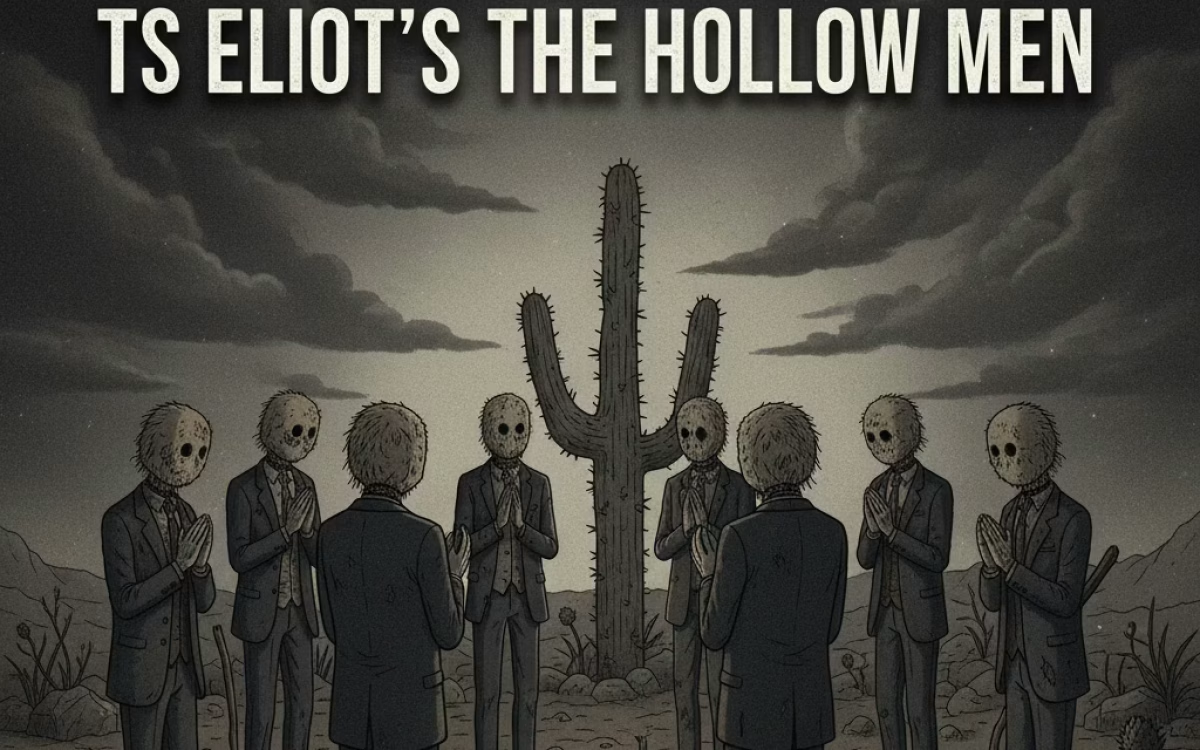
Hollow yet stuffed, these paradoxes evoke scarecrows—effigies, not humans, incapable of real emotion or resolve.
“Headpiece filled with straw”—the allusion is plain for any British reader as a reference to Guy Fawkes, but for the Indian reader, think of any festival or ritual involving symbolic effigies.
The chorus of voices is muted, weary, and resigned—”Our dried voices, when / We whisper together / Are quiet and meaningless / As wind in dry grass.”
Part II: Eyes and Spiritual Blockage
Eyes, in Eliot’s work, usually signify spiritual vision—here, the hollow men cannot meet “death’s dream kingdom”, or the transcendent.
They “dare not meet” the judging eyes—neither in dreams nor daylight—hinting at fear of divine audit or moral reckoning.
The hollow men don “deliberate disguises”, wishing to hide from uncomfortable truths.
Part III: Barren Landscapes
“This is the dead land / This is cactus land”—here, Eliot’s imagery evokes a spiritual desert as he did in “The Waste Land”.
Rituals are empty, “Supplication of a dead man’s hand / Under the twinkle of a fading star,” offering no hope or renewal.
The cactus may evoke the barren, drought-prone regions of India, and Eliot’s reference applies to both the Deccan plateaus and the bleakest Western terrain.
Part IV: The Valley of Dying Stars
The world is “a valley of dying stars” and “this hollow valley”, a place where “the eyes are not here”.
“Here we grope together…gathered on this beach of the tumid river” alludes to the River Styx, a liminal space between life and death.
The absence of vision (“no eyes here”) crystallises the poem’s spiritual crisis—without guiding stars, one is lost, blind.
Part V: Children’s Rhyme and Final Descent
“Here we go round the prickly pear”—childish sing-song morphs into existential despair.
The prickly pear replaces the traditional mulberry bush, suggesting a harsh, inedible world. This playful tone stands in tragic contrast to the poem’s dark argument.
The closing lines—repeated, diminishing refrains—bring the famous conclusion:
“This is the way the world ends / Not with a bang but a whimper.”The poem does not imagine apocalypse but a slide into insignificance—a theme global readers recognise in times of crisis, environmental degradation, or moral apathy.
The Hollow Men Analysis: Symbolism, Imagery, and Allusion
The po is rich in intertextuality, challenging students, teachers, and scholars to decode its references and symbols.
Scarecrow Motif: Symbolises humanity’s loss of spiritual substance, echoing colonial encounter effigies and “Burning Man” rituals in global cultures.
Eyes: Historically loaded—suggesting the divine, conscience, judgement, and memory.
Desert/Nature Imagery: Represents barrenness; however, in regions like Rajasthan or the western U.S. deserts, it also signifies resilience, which is a contrast that Eliot avoids, thereby deepening his pessimism.
Whimper vs. Bang: Eliot’s conclusion subverts audience expectations, warning that most cultural decline happens not in an instant, but over decades—a warning for all rapidly changing societies.
The Hollow Men Analysis: Eliot’s Career
Placed between “The Waste Land” (1922) and “Ash Wednesday” (1930), “The Hollow Men” marks an important shift in Eliot’s work. It moves from intense despair toward a tentative spiritual searching. Published in 1925, the poem captures a conflicted vision of inertia and longing. For readers in 2025, this vision resonates amid ongoing debates about tradition, progress, and cultural memory. The poem stands as both a culmination of Eliot’s early Modernist phase and a bridge toward new religious exploration.
Comparisons to The Waste Land
| Aspect | The Hollow Men | The Waste Land |
|---|---|---|
| Tone | Bleak, resigned, introspective | Fragmented, condensed, satirical |
| Imagery | Desert, scarecrow, twilight | Ruins, water, city crowds |
| Structure | Five sections, repeating refrains | Mixed forms, multiple voices, free verse |
| Ending | Fades out (“a whimper”) | Hints at renewal or despair |
Critical Reception and Modern Legacy
While early critics found “The Hollow Men” almost nihilistic, contemporary analysis has highlighted its subtle hope—a yearning for renewal despite despair. Its lines circulate in classrooms, critiques, and cultural commentary, cited whenever society confronts its own moral or ideological vacuum. EXPLORE OTHER WORKS
Conclusion
T.S. Eliot’s “The Hollow Men” calls for more than careful reading. It demands active engagement and deep self-reflection. The poem reveals the dangers of spiritual emptiness and social stagnation. For anyone searching for meaning, integrity, or purpose amid overwhelming challenges, it remains essential.
In today’s turbulent world, Eliot’s elegy is not just a text to study. It is a powerful prompt for action. Instead of ending with dramatic redemption, the poem quietly fades into resignation. Eliot suggests that spiritual emptiness rarely causes sudden catastrophe. Rather, it leads to a slow, collective fading away.
The haunting repetition, “This is the way the world ends / Not with a bang but a whimper,” whispers a warning. The greatest threat to humanity is not sudden disaster but our own inertia, doubt, and loss of conviction. Eliot presents a bleak, honest vision. He confronts readers with the moral, emotional, and cultural consequences of disengagement.
By holding a mirror to the hollow men of his time—and ours—Eliot invites not only analysis but also a call to action. He urges us to seek substance, compassion, and meaningful action in a world often content with shadows and echoes.
FAQs
Who are “the hollow men”?
They represent spiritually barren modern humanity, unable to act meaningfully or connect deeply in a fractured world.
What is the meaning behind “Not with a bang but a whimper”?
Eliot suggests that the decline of cultures and people happens gradually, through inaction and loss of purpose rather than dramatic events.
Why does Eliot use so many allusions?
Allusions enrich the poem’s meaning and reflect the fragmentation and loss of a unified cultural or spiritual narrative.
How is the poem relevant today?
Themes of emptiness, cultural crisis, and paralysis resonate powerfully in today’s globalised, high-tech, but often spiritually disconnected society.
.