Introduction
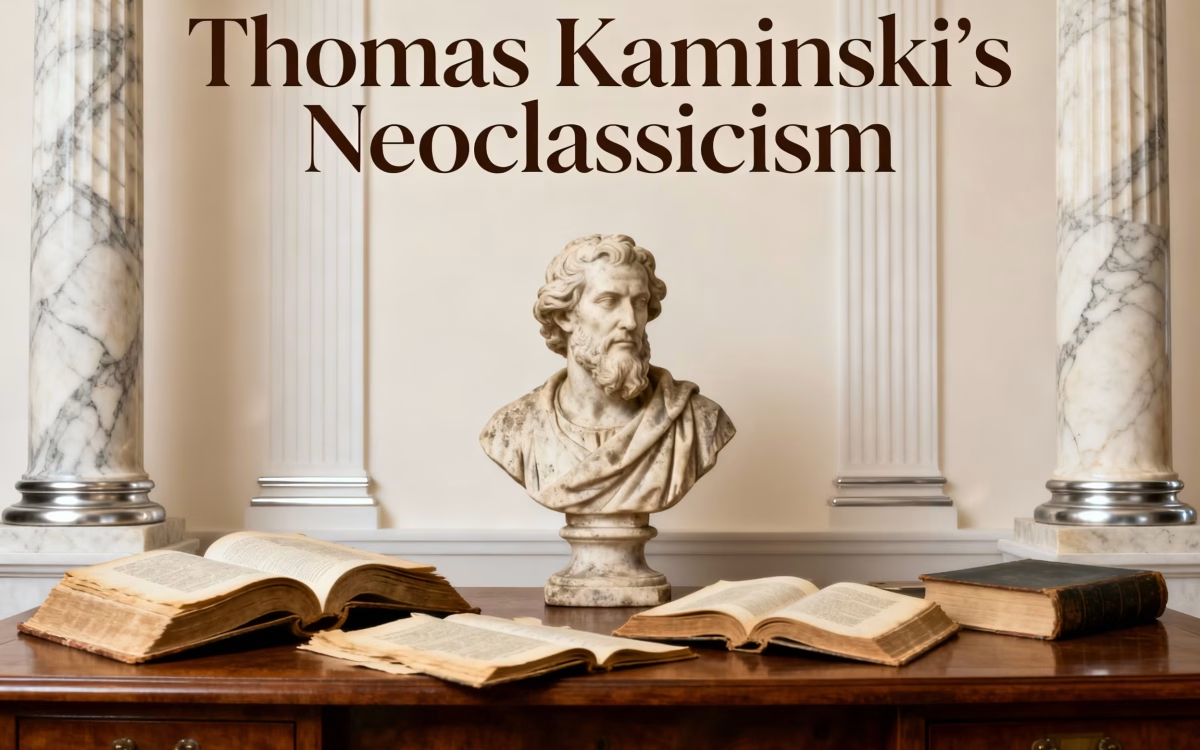
Thomas Kaminski’s Neoclassicism in literature compellingly captures the moment when Europe deliberately looked to the ancient past to become modern.
From about 1660 to 1800, writers in France and England consciously adopted classical genres, techniques, and ideals. They aimed to craft what they saw as the most sophisticated and modern form of writing. Rather than treating Greek and Roman texts as untouchable relics, neoclassical authors transformed them into a living toolkit. They borrowed structures, reshaped myths, and refined language so the old world could speak sharply to the new. This ambition—to renovate, not merely repeat antiquity—leads Kaminski to call neoclassicism “the true modern style.” It challenges the idea that the period was rigid or rule-bound.
In course outlines, neoclassicism often appears as a list of dates, names, and “rules of art.” These include decorum, the unities, the heroic couplet, and an emphasis on reason and balance. Kaminski argues that behind these tidy categories lies a more dynamic story. It shows how societies negotiate change through their cultural inheritance. Poets like Dryden and Pope imitate Horace, while French dramatists measure themselves against Sophocles and Euripides. They do this not only to pay homage but to use ancient voices to comment on monarchy, urban corruption, religious tension, and the emerging public sphere of coffee-houses and print. Through this process, the classical past becomes a precise instrument for modern criticism.
From this perspective, neoclassicism stops looking like a dry prelude to Romanticism. Instead, it appears as a deliberate experiment in cultural engineering. Writers tighten language, regulate form, and favour reason—not because they reject passion or imagination, but because they see discipline as essential. Such a style can steady a world shaken by civil war, revolution, and rapid social change. Kaminski traces this confidence in form from early seventeenth-century reforms in French verse to the mature Augustan style. He shows how writers use classical history—especially Horace’s account of Rome’s literary evolution—as a model for national self-understanding in France and England. FULL TEXT
Thomas Kaminski’s Neoclassicism: “true modern style”
Kaminski notes that scholars usually link the 1660–1800 period to the classical tradition, especially in France and England. Labels like “classicism” and “neoclassicism” remain standard in criticism and syllabi. For Kaminski, the neoclassical style is “true modern” because it reflects a deliberate, theoretically grounded choice: writers measure their work against ancient models to achieve greater polish, clarity, and structural coherence than earlier vernacular traditions.
This “modern” quality has three strands. First, a mythic history where Rome’s Augustan age becomes a template for literary maturity. Second, a programmatic turn to genres like satire, epic, tragedy, and Horatian epistle. Third, a shared belief that disciplined language can mirror rational thought and help stabilise a rapidly changing social order. This theory is a consciously theorised aesthetic, not just a habit of writing couplets.
Thomas Kaminski’s Neoclassicism: Political and Social
Neoclassicism in literature is more than a stylistic trend; it is a deliberate political and social project. Authors used classical forms and models not only for aesthetic polish but to offer sharp commentary on power structures, moral climates, and public debates of their time. Augustan writers, in particular, turned allusions to Greece and Rome into coded critiques of kings, ministers, corruption, censorship, liberty, and responsibility, often without naming them directly. Classical satire, epic, and epistle became tools for negotiating the tensions of a rapidly changing society.
Neoclassical texts frequently stage debates about how communities should be organised and what behaviour merits praise or blame. The balance of a heroic couplet or the strict observance of dramatic unities reflects a desired civic balance: order over chaos, reason over impulse, measured judgement over factional rage. Literature becomes a forum where writers test authority, examine the ethics of patronage and publicity, and model a rational, debating public.
Thomas Kaminski’s Neoclassicism: Key characteristics
Emphasis on reason and order:
Neoclassical literature prioritises clarity, logic, and structured expression, reflecting Enlightenment ideals that valued rational thought and disciplined thinking over emotional excess or spontaneity.
Adherence to classical rules and forms:
Writers followed strict conventions derived from ancient Greek and Roman models, such as the unities in drama, balanced syntax in poetry, and well-defined genre boundaries, aiming for coherence and perfection in form.
Moral and didactic purpose:
Many neoclassical works aim to instruct, correct or satirise social behaviour, often using allegory, fable or satire to highlight flaws in human nature and society.
Preference for public, universal themes:
Neoclassical authors typically address broad social, political or philosophical issues rather than personal, private experiences, making their work accessible and relevant to a wider audience.
Use of satire and irony:
Satire became a hallmark of the period, with writers like Pope and Swift using wit and irony to critique contemporary politics, society and culture, often through classical allusions and mock-heroic forms.
Focus on decorum and appropriateness:
Neoclassical literature stresses the importance of decorum—ensuring that style, tone and content suit the genre and audience, avoiding excess or inappropriateness.
Realistic portrayal of human nature:
Characters in neoclassical works are depicted as flawed, social beings shaped by institutions and societal pressures, rather than as idealised heroes or purely romantic individuals.
Polished and restrained language:
The language is carefully crafted, avoiding obscurity and affectation, favouring clarity, precision and elegance to communicate ideas effectively.
Engagement with tradition:
Neoclassical writers frequently draw on classical mythology, history and literature, not as mere imitation, but as a means to connect the present with the past and to comment on contemporary issues.
Public and social orientation:
Literature is seen as a public art form, intended to shape public taste, influence social norms, and contribute to the moral and intellectual improvement of society.
Thomas Kaminski’s Neoclassicism: Period divisions
Standard handbooks divide neoclassicism into the Restoration, Augustan, and late eighteenth-century—or “Age of Johnson”—phases. Kaminski adopts this framework but emphasises that the boundaries between these phases are porous.
The Restoration period, beginning in 1660, marked the return of the monarchy and the reopening of theatres. It also brought a surge of experimental drama and prose inspired by classical comedy and tragedy. Meanwhile, writers navigated a traumatised society still reeling from civil war. This blend of renewal and reflection gave the literature of the time both energy and moral tension.
The Augustan phase, lasting from the early to mid‑eighteenth century, represents the height of neoclassicism in literature. It is defined by sharp satire, elegant heroic couplets, and urbane essays. Moreover, new prose forms such as periodicals and the early novel began to flourish, shaping the modern literary landscape.
By the 1790s, however, Romanticism started to gain momentum. Therefore, the neoclassical ideal of rational and rule‑based art faced strong opposition. Writers began to emphasise imagination, nature, and personal experience instead. Yet, the transition between these movements was gradual and complex rather than a sudden break. In fact, elements of reason and emotion continued to coexist within this evolving literary tradition.
Thomas Kaminski’s Neoclassicism: language, rules and taste
Kaminski links neoclassical creative writing with neoclassical criticism, highlighting figures like Boileau in France and Dryden and Johnson in England. These critics argued that literature should follow “nature,” as understood through reasoned reflection on classical models. The critical tradition holds that rules are not arbitrary; scholars distill them from long observation of what works in the best Greek and Roman texts and adapt them for contemporary languages and audiences.
Language is a central concern. Critics warn against obscurity, affectation, and “false wit,” promoting clear, distinct ideas and a relatively plain style that still allows for wit and elegance. In modern classrooms, neoclassical criticism helps students consider decorum—what suits a genre or situation—as well as audience expectations and the ethics of representation, long before these ideas entered current theoretical vocabulary. EXPLORE OTHER WRITINGS
Genre choices: satire, epic, drama and essay
One of the easiest ways to see neoclassicism in practice is to track which genres writers favour and how they reshape them.
Satire and mock‑epic: Drawing on Juvenal and Horace, neoclassical satirists adapt epic conventions to trivial modern quarrels, exposing vanity and social absurdity while implicitly measuring contemporary life against an ideal of rational order.
Drama: French “classical” tragedy under Racine and Corneille rigorously pursues unity of time, place and action, while English Restoration and early eighteenth‑century drama mixes this classical aspiration with a more flexible, often bawdy engagement with current manners.
Essay and periodical writing: The emergence of the essay in Addison and Steele, and later Johnson, represents a neoclassical desire to bring rational, moral discourse into everyday life through accessible prose that still respects classical ideals of structure.
Kaminski reads these genre choices as part of a broader neoclassical ambition: to build a literate public capable of self‑scrutiny, argument and moral judgement, using literature as a training ground.
Human nature, reason and limitation
A striking feature of neoclassicism in literature, highlighted in both Kaminski’s chapter and broader movement overviews, is its frank acknowledgement that human beings are inconsistent and often irrational. Unlike the Renaissance, which often idealised humanity, neoclassical writers instead present flawed characters caught between reason and passion, habit and principle, social role and private desire.
Moreover, this realism is framed by a belief that reason and common sense should still serve as guides, even if they never fully master impulse. As a result, the didactic edge in many neoclassical works reflects a conviction that literature can gently correct—or at least expose—folly by staging it within familiar social settings and recognisable types.
Thomas Kaminski’s Neoclassicism: Movement traits
| Aspect | Kaminski’s emphasis | Broader accounts of neoclassicism in literature |
|---|---|---|
| Historical span | 1660–1800 as a period consciously aligned with classical tradition | Typically 1660–1798, from Restoration to the publication of Lyrical Ballads |
| Core idea | Neoclassical style as “true modern style,” renovating the past for contemporary purposes | Revival of Greco‑Roman principles stressing reason, harmony and order |
| Politics | “Politics of Augustanism”: classical reference used to negotiate monarchy, liberty and patronage | Engagement with Enlightenment ideals, social hierarchy and emerging public sphere |
| Genres | Focus on satire, Horatian imitation, and public poetry as vehicles for critical modernity | Satire, mock‑epic, didactic verse, drama observing unities, polished essays |
| View of human nature | Flawed, socially embedded subjects needing form and reason as restraints | Realistic, conservative characters governed by common sense and decorum |
Conclusion
Neoclassicism in literature stands as a testament to the enduring power of tradition when reimagined for modern times. Far from being a mere imitation of ancient forms, neoclassicism was a dynamic and purposeful movement. It used classical ideals to address the political, social, and intellectual challenges of its era. Writers of this period crafted polished and structured works that explored morality, governance, and public life. Through their writings, literature became a tool for both critique and civic education.
The legacy of neoclassicism extends beyond the past. Its focus on reason, order, and moral purpose still shapes modern debates about art and literature. By balancing tradition with innovation, neoclassical authors renewed the wisdom of antiquity for a changing world. Their works offer lasting lessons in clarity, decorum, and responsible language use.
FAQS
What is neoclassicism in literature?
Neoclassicism in literature refers to a movement from roughly 1660 to 1798 that revived the ideals, forms, and values of ancient Greek and Roman literature, emphasising reason, order, and structure over emotional expression and individualism.
What are the main characteristics of neoclassical literature?
Key features include a focus on reason, clarity, and balance; adherence to classical rules and forms; moral and didactic purpose; realistic portrayal of human nature; and the use of satire and irony to critique society.
Who are some prominent neoclassical writers?
Major neoclassical authors include John Dryden, Alexander Pope, Samuel Johnson, and Joseph Addison, all of whom contributed significantly to poetry, essays, and satire, drawing inspiration from classical models.
Why did neoclassical writers favour classical forms?
Neoclassical writers believed that classical forms provided the best models for achieving clarity, moral instruction, and social order. They valued tradition, craftsmanship, and the discipline of form as a way to counter chaos and excess in society.
How does neoclassicism differ from Romanticism?
Neoclassicism emphasises reason, order, and restraint, while Romanticism focuses on emotion, imagination, and individual experience. Neoclassical literature tends to be structured and didactic, whereas Romantic works are more spontaneous and expressive.