Introduction
Abrams’ Orientation of Critical Theories is a foundational text that has shaped how generations of students and scholars approach literature. At its core, Abrams’ framework offers a simple yet powerful way to understand the diverse landscape of literary theory by mapping it onto four fundamental elements: the universe (the world), the work (the text), the artist (the author), and the audience (the reader).
This approach is more than just a clever diagram; it’s a conceptual toolkit that helps learners navigate the sometimes overwhelming array of critical schools—from classical mimesis to modern formalism, from Romantic expressivism to pragmatic reader-response theories.
But why does this matter so much in today’s classroom? The answer lies in the way Abrams’ model bridges historical depth and practical clarity. Instead of treating literary criticism as a series of disconnected “isms,” he shows that most theories are variations on a few enduring questions: How does literature relate to the world? What is its purpose for the audience? How does the author’s mind shape the work? And what makes a text stand on its own? By answering these questions, students can move beyond rote memorisation and engage with criticism as a living, evolving conversation.
In this article, we’ll explore Abrams’ “Orientation of Critical Theories” in detail, exploring each of the four orientations—mimetic, pragmatic, expressive, and objective—and showing how they can be applied to real-world examples. We’ll also reflect on the strengths and limitations of Abrams’ model, considering how it holds up in the face of newer theoretical developments.
By the end of this piece, you’ll have a clear, well-structured understanding of Abrams’ fourfold map of literary criticism—a framework that continues to inspire and inform literary study around the world.
Abrams’ Orientation of Critical Theories: Historical Context
Abrams’ “Orientation of Critical Theories” emerged at a pivotal moment in literary criticism. The mid-20th century saw major shifts in intellectual thought. English literature studies were evolving rapidly. Abrams’ essay opened his landmark book, The Mirror and the Lamp (1953). It aimed to offer a clear framework for understanding centuries of critical approaches. Literary theory was becoming fragmented. New schools like New Criticism, structuralism, and existentialism gained attention. Abrams’ fourfold map brought much-needed clarity. It offered coherence in a crowded field.
The historical context of Abrams’ work is rooted in the Romantic tradition. He studied it and helped redefine it. Before Romanticism, Western criticism focused on the mimetic paradigm. Literature was seen as a mirror of the external world. This approach dominated from Plato and Aristotle to the Renaissance and Enlightenment. It stressed the work’s link to reality, morality, and social order. Then, around 1800, everything changed. The artist shifted from a passive reflector to an active creator. Inner vision and imagination became central to literary production.
Abrams traced this evolution. The pragmatic orientation—concerned with literature’s effects on the audience—held sway from Horace through the 18th century. Later, the expressive orientation took over in Romantic thought. The artist became the focus. The objective orientation, which treats the work as an autonomous object, grew stronger in the 20th century. Formalism and New Criticism played key roles. Abrams mapped these shifts. He showed how each orientation reflected broader cultural, philosophical, and scientific developments. For example, Hobbes and Locke’s psychology influenced 17th-century criticism.
“Orientation of Critical Theories” is more than a theoretical exercise. It is a product of its time. It responded to the need for a unifying framework in an age of critical pluralism. Abrams’ work still resonates. It captures the dynamic interplay between tradition and innovation. It gives readers a way to situate themselves in the ongoing conversation about literature and criticism. FULL TEXT
Abrams’ Orientation of Critical Theories: The Four Elements
The four elements in M.H. Abrams’ “Orientation of Critical Theories” form the core of his framework for understanding literary criticism. These elements are:
The Universe (World/Reality)
The Work (Text/Artwork)
The Artist (Author/Creator)
The Audience (Reader/Observer)
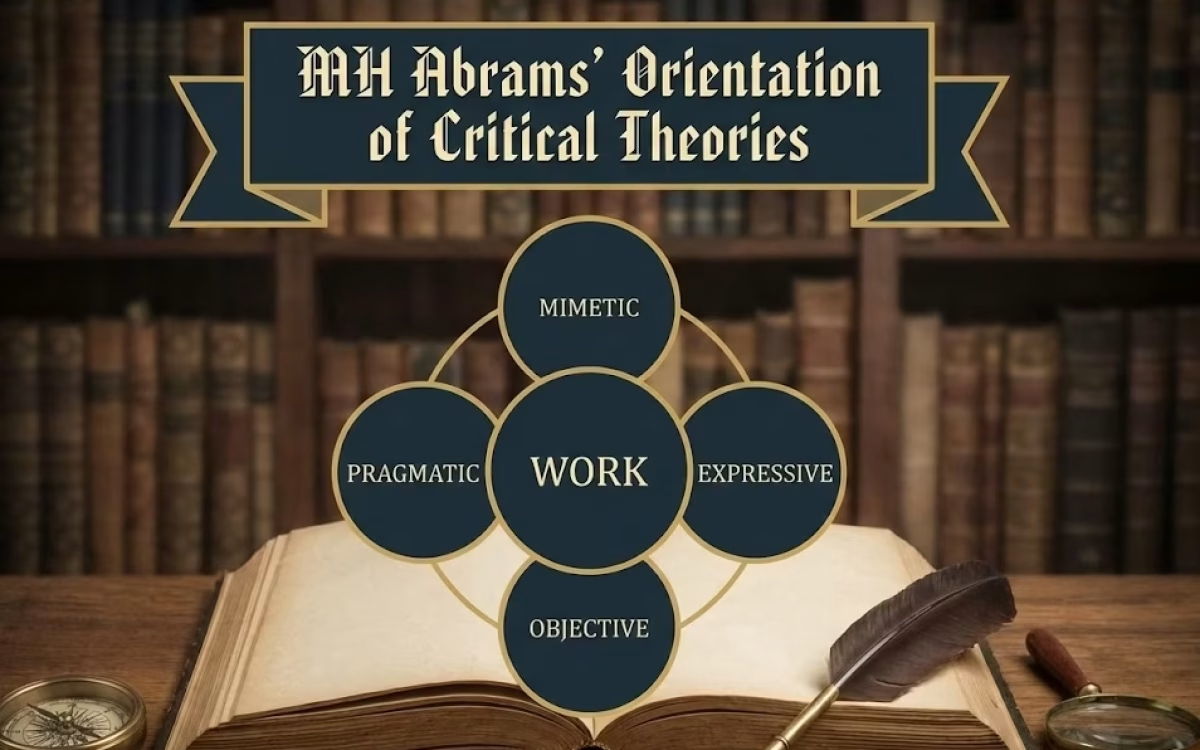
Abrams places these elements around the central work of art, creating a diagram that visually represents the relationships between them. The work sits at the center, with the universe, artist, and audience positioned around it, each connected to the work and to one another. This diagram illustrates how different critical theories orient themselves by focusing on one or more of these elements.
The Universe (World/Reality): This refers to the external world, nature, society, or any reality that the work represents or imitates. Mimetic theories focus on this element, examining how the work reflects or interacts with the world.
The Work (Text/Artwork): The work itself is the central object of study. Objective theories emphasise the internal structure, language, and formal aspects of the work, treating it as an autonomous entity.
The Artist (Author/Creator): This element concerns the mind, emotions, and intentions of the author. Expressive theories highlight the artist’s inner life and how it is expressed through the work.
The Audience (Reader/Observer): The audience’s response, interpretation, and experience are central to pragmatic theories, which focus on the effects of the work on its readers or listeners.
Four Critical Theories
M.H. Abrams’ “Orientation of Critical Theories” is built on the idea that all literary criticism, in one way or another, revolves around four fundamental elements: the universe (the world), the work (the text), the artist (the author), and the audience (the reader). These elements form the basis of four major critical theories—Mimetic, Pragmatic, Expressive, and Objective. Each theory offers a unique lens for analysing literature, and together they provide a comprehensive framework for understanding the diverse approaches to literary criticism.
Mimetic Theories
Mimetic theories are rooted in the classical tradition and focus on the relationship between the literary work and the external world or reality. This approach sees literature as a form of imitation (mimesis) of life, nature, or the universe. Plato, one of the earliest proponents of mimetic theory, argued that art is twice removed from truth, as it imitates the physical world, which itself is an imitation of the ideal world. Aristotle, however, viewed imitation as a natural human instinct and a means to understand and represent reality. Mimetic criticism is concerned with how accurately or truthfully a work reflects its subject, making it central to discussions of realism, social commentary, and historical context in literature. For example, when analysing a novel like Charles Dickens’ Hard Times, mimetic critics would examine how the novel reflects the social and economic conditions of Victorian England.
Pragmatic Theories
Pragmatic theories emphasise the relationship between the literary work and its audience, focusing on the effects that literature produces on readers. This orientation has its roots in ancient rhetoric and didactic traditions, where the primary purpose of art was to teach, please, or move the audience. Thinkers like Horace and Aristotle (in his Poetics) argued that literature should instruct, delight, or stir emotions. Sir Philip Sidney’s “Apologie for Poetry” further expanded this idea, suggesting that poetry is superior to history because it can inspire moral improvement by depicting not just what has been, but what might be. Pragmatic criticism is often found in discussions about the moral, social, or psychological impact of literature, as well as in reader-response theory. For instance, when analysing Shakespeare’s Hamlet, pragmatic critics might explore how the play affects the audience’s emotions and moral understanding.
Expressive Theories
Expressive theories centre on the artist—the creator of the work—and view literature as an expression of the author’s inner life, emotions, and imagination. This approach gained prominence with the Romantic movement, when the focus shifted from the work’s relation to the world or audience to the artist’s subjective experience. Romantic poets like Wordsworth and Coleridge saw poetry as the spontaneous overflow of powerful feelings, and critics began to interpret works by exploring the author’s biography, intentions, and emotional state. Expressive criticism is evident in biographical and psychological approaches to literature, where the work is seen as a window into the artist’s mind. For example, when analysing Wordsworth’s “Tintern Abbey,” expressive critics would focus on the poet’s personal experiences and emotional journey.
Objective Theories
Objective theories treat the literary work as an autonomous object, focusing on its internal structure, language, and formal elements rather than its relation to the world, audience, or artist. This orientation became dominant in the 20th century with the rise of formalism and New Criticism. Critics like T.S. Eliot and Cleanth Brooks emphasised close reading and the analysis of literary devices, arguing that a work’s value lies in its organic unity and the interplay of its parts. Objective criticism is concerned with the text itself, examining imagery, symbolism, narrative technique, and structure, often without reference to external contexts. For example, when analysing T.S. Eliot’s “The Waste Land,” objective critics would focus on the poem’s structure, imagery, and use of symbolism, rather than its historical or biographical context.
Each of these four theories provides a distinct lens through which to analyse literature, and together they offer a comprehensive framework for understanding the diverse approaches to literary criticism.
Abrams’ Orientation of Critical Theories: Historical Sequence
One of Abrams’ key insights is that these four orientations do not appear randomly. Instead, they form a loose historical sequence in the dominant tendencies of Western criticism. For many centuries, mimetic and pragmatic views prevailed, focusing on representation and audience effect. Then, expressive theories rose with Romanticism. Later, objective theories gained strength in the twentieth century.
However, Abrams is careful to stress that this is a matter of dominance, not exclusivity. Elements of each orientation can be found at many historical moments. No period is completely uniform. This nuanced sense of historical layering allows students to move beyond simplistic timelines. For example, modern criticism can still invoke classical mimetic concerns or Romantic expressiveness. At the same time, it may claim to be purely formal or structural.
Abrams’ Orientation of Critical Theories: Strengths and Limitations
The main strength of Abrams’ “orientation of critical theories” lies in its clarity and flexibility. It simplifies complex ideas without oversimplifying them. Moreover, it can accommodate a wide range of critical approaches. By insisting that no theory can completely ignore the work, the world, the artist, or the audience, Abrams prevents readers from treating any single element as an absolute centre. As a result, he encourages comparison rather than dogmatic allegiance.
Yet, Abrams’ scheme also has limitations. Later theorists have not been shy to point out these weaknesses. For instance, some argue that newer forms of criticism—especially those focused on language, discourse, ideology, or power structures—do not fit neatly into the fourfold map. In addition, the model still assumes a stable “work” and “author,” which poststructuralist thought questions. For students, keeping these critiques in view can be healthy. It reinforces the idea that Abrams offers a strong starting point, not a final settlement, in the ongoing debate about what literary criticism should prioritise. EXPLORE OTHER WORKS
Conclusion
Abrams’ “Orientation of Critical Theories” remains a cornerstone in the study of literary criticism. Indeed, it offers a structured and accessible framework that continues to guide students, scholars, and educators worldwide. By mapping the landscape of criticism onto four fundamental elements—the universe, the work, the artist, and the audience—Abrams provides a versatile tool for analysing and comparing diverse critical approaches. Furthermore, this fourfold scheme not only simplifies the complexity of literary theory but also encourages a deeper, more reflective engagement with texts. As a result, readers can see how different theories highlight various aspects of literature.
The enduring value of Abrams’ model lies in its clarity and flexibility. In fact, it enables learners to situate classical, Romantic, modern, and contemporary critical schools within a single, coherent diagram. Therefore, it becomes easier to understand the historical evolution of literary thought. For example, whether one is exploring the mimetic concerns of Plato and Aristotle, the pragmatic aims of Horace and Sidney, the expressive impulses of Wordsworth and Coleridge, or the objective focus of New Critics, Abrams’ framework provides a common language and a shared point of reference.
Moreover, Abrams’ approach fosters critical thinking by emphasising that no single theory can capture the entirety of literature. Instead, each orientation offers a partial but valuable perspective. Consequently, the richness of literary criticism emerges from the interplay of these different viewpoints. This recognition encourages readers to move beyond rigid categorisations. Additionally, it helps them appreciate the dynamic, evolving nature of literary study.
In conclusion, Abrams’ “Orientation of Critical Theories” is more than just a historical overview. Rather, it is a practical and intellectual toolkit that continues to inspire and inform the study of literature. By providing a clear, systematic framework, Abrams empowers readers to navigate the complexities of literary criticism with confidence and insight. Thus, his work remains a vital resource for generations to come.