Introduction
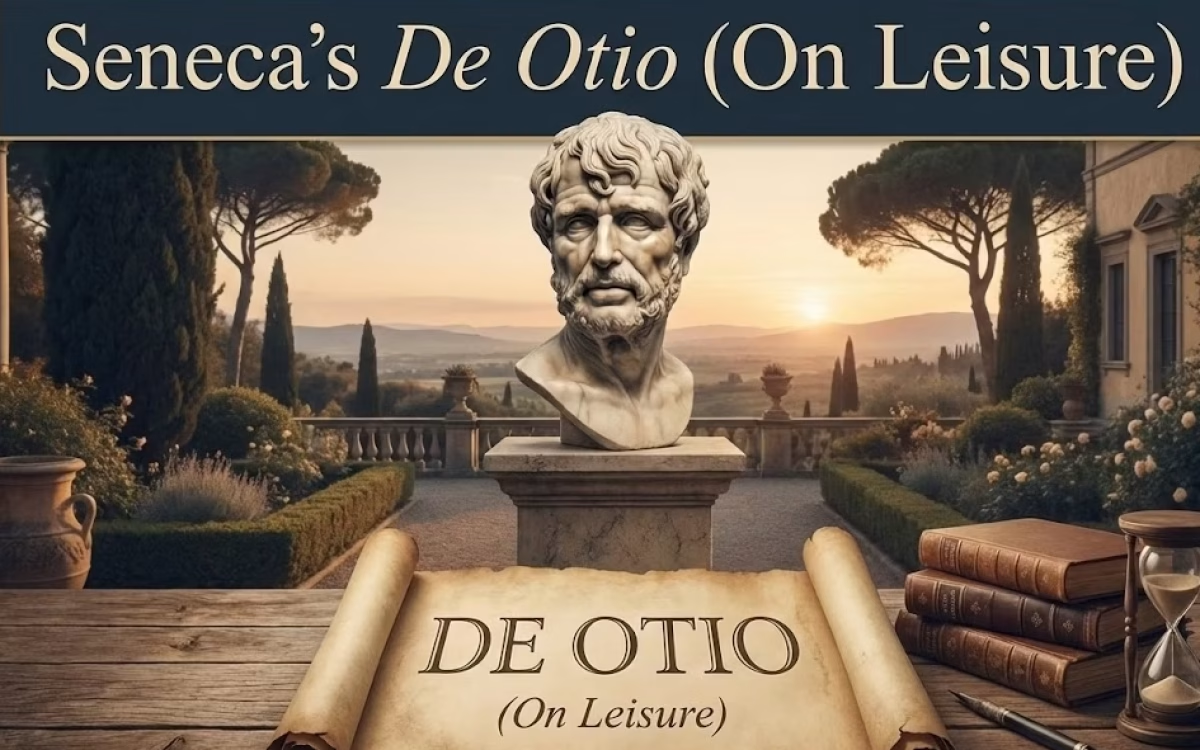
Seneca’s De Otio, usually translated as On Leisure, is a brief but provocative Stoic dialogue. It asks a very modern question: what should a wise person do with spare time in a noisy and demanding world? Written in first-century Rome, probably around the early 60s CE, the text survives in fragmentary form. Yet it still speaks powerfully to anyone caught between public responsibilities and the desire for a more reflective life.
In De Otio, Seneca challenges the idea that leisure means mere idleness or escape. Instead, he argues that true otium—rightly understood—serves humanity through philosophy, contemplation, and participation in the rational order of the cosmos. When read from a twenty-first-century Indian classroom or a busy faculty office, this insight cuts close to the bone. Leisure becomes not an excuse to log off but a demanding invitation to think, write, and teach more deeply.
From the start, De Otio sets itself against two extremes: restless activism and selfish retreat. Seneca knows the traditional Stoic preference for public life, yet he dares to claim that in corrupt conditions, withdrawing into philosophical leisure can be the more ethical choice. That tension—between the forum and the study, the crowd and the self—is what makes this short treatise such a rich text for readers trying to balance visibility with integrity.
Seneca’s De Otio: Text, Context and Stoic Background
De Otio is part of Seneca’s wider corpus of ethical essays and dialogues, including On Anger, On Clemency, On Tranquility of Mind, and On the Shortness of Life. Together, these texts develop a distinctively Roman version of Stoicism that emphasises inner freedom, rational self-governance, and the cultivation of virtue in turbulent political times.
In the broader Stoic tradition, the wise person usually takes part in public life, serving the community through political and social engagement. The ideal sage is a citizen of two commonwealths: a local city and a cosmic city ruled by divine reason. De Otio revisits this standard teaching but twists it in a daring way. It suggests that service to the cosmic city can justify stepping away from direct political action when circumstances are hostile or morally compromising.
Historically, Seneca wrote De Otio under Emperor Nero, after years of dangerous proximity to power. Many scholars interpret it as partly autobiographical: a philosopher tries to work out whether someone who withdraws—or is pushed aside—can still benefit others. FULL TEXT
Seneca’s De Otio: An Overview
Although the work is incomplete, the main argument of De Otio emerges clearly. Seneca starts by acknowledging the Stoic tradition’s emphasis on public service. He cites the view that a wise person naturally joins political life unless special circumstances prevent it. Gradually, he opens up another possibility: the wise can choose otium—a life of philosophical leisure—without breaking Stoic principles.
In the middle chapters, Seneca redefines otium. Leisure is not a retreat into laziness or luxury. Instead, it becomes a space for deep contemplation of nature, human affairs, and divine reason. By aligning the mind with the rational order of the universe, the philosopher joins a “greater commonwealth” that goes beyond any single city or empire. From this cosmic viewpoint, even a life in solitude can help improve humanity.
The surviving sections of De Otio explore how different ways of life—pleasure, contemplation, and action—relate to each other. Seneca stresses that philosophical leisure is not mere self-absorption. He argues that contemplation enriches action, and the writings, ideas, and moral example of the wise have lasting effects beyond their immediate circles. The treatise ends (as far as the fragments show) with a complex image of the sage: someone who serves both the local community and the cosmic order, even when removed from the forum.
Stoic View of Leisure in De Otio
At the heart of Seneca’s On Leisure is a paradoxical claim: stepping away from public office can be the most generous way to live. For a Stoic, what counts is not just outward activity, but aligning one’s rational soul with the divine logos that shapes the universe. If political life stands in the way of this alignment—because of tyranny, corruption, or endless distraction—then retreating into otium protects both personal integrity and philosophical productivity.
Seneca contrasts two kinds of busy people: those preoccupied with fleeting tasks and honours, and those who remain inwardly active even in retirement. Modern scholars often highlight his critique of the occupati—people whose days are packed but whose lives feel strangely empty. In this framework, leisure is not a break from seriousness. Instead, it creates the space needed to think deeply and meaningfully.
Seneca De Otio Analysis: Politics, Cosmopolitanism, and Inner Freedom
One of the most striking features of Seneca’s De Otio is its shift from local to cosmic politics. Seneca draws a clear line between a “lesser” commonwealth—the specific city or empire—and a “greater” commonwealth, the entire rational universe ruled by divine reason. He argues that a philosopher in otium can serve the greater commonwealth more effectively by studying nature, ethics, and human psychology than by chasing offices in the lesser one.
Scholars often interpret this argument as a form of Stoic cosmopolitanism. Every rational being shares in the same universal reason, so the true city of the sage is not Rome, but the cosmos itself. De Otio turns exile, retirement, or marginalisation into chances to embrace this broader identity. From this perspective, distinctions of nation, class, or local prestige fade away. What matters is whether the soul grows in virtue and clarity.
Relevance Today
From a historical angle, De Otio deepens our understanding of Roman Stoicism and Seneca’s intellectual journey. It reveals how a philosopher caught up in imperial politics tried to justify retreat without giving up his duty to help others. For classicists, the treatise links with other dialogues addressed to Serenus, where themes of inner stability, tranquility, and steadfastness come up again and again.
From a broader human perspective, the text acts like a mirror to contemporary life. In a world where notifications and endless scrolling rule free time, De Otio challenges us to ask if we have the courage to use leisure differently. It invites readers to see leisure as a disciplined, intellectually serious practice that connects us more closely to the human community and the rational order we inhabit.
Over the years, many teachers and writers have found that their most meaningful work comes not from busy schedules but from moments of quiet, even boredom. That is where new ideas emerge, connections form, and long-avoided questions finally get answered. Seneca, writing almost two thousand years ago, would likely nod in agreement. EXPLORE OTHER WRITERS
Key ideas in Seneca’s De Otio
| Aspect | Key points |
|---|---|
| Work and date | Short Latin treatise, De Otio (On Leisure), written by Seneca around the early 60s CE, surviving in fragmentary form. |
| Main question | Should a Stoic wise person engage in public life or withdraw into philosophical leisure, especially in corrupt or hostile circumstances? |
| Concept of otium | Leisure is redefined as active, contemplative service to the wider human community and the rational cosmos, not as idle retirement. |
| Political angle | Distinguishes between a “lesser” civic commonwealth and a “greater” cosmic commonwealth, favouring service to the latter when politics is morally compromised. |
| Relevance today | Speaks to modern overwork, digital distraction, and the Indian academic/corporate culture of busyness, encouraging reflective, value‑oriented use of free time. |
Conclusion
Seneca’s De Otio (On Leisure) offers a timeless reflection on the value of thoughtful rest and philosophical contemplation in a world obsessed with constant activity. True leisure is not about idleness or escape. Instead, it means engaging deeply with ideas, ethics, and the rational order of the universe. Seneca challenges us to rethink how we spend our time, urging a move away from superficial busyness toward meaningful, reflective engagement.
This ancient text remains strikingly relevant in today’s fast-paced, digitally saturated environment. For students, academics, and professionals in India and beyond, embracing Seneca’s vision of otium can help cultivate inner freedom, clarity, and a deeper sense of purpose, even amid overwhelming demands. It invites us to see leisure not as a luxury, but as a disciplined practice that benefits both the individual and the wider community.
Seneca’s De Otio encourages us to question the culture of perpetual busyness. It urges us to reclaim our time for contemplation, creativity, and ethical growth. Whether you are preparing for competitive exams, managing academic responsibilities, or simply seeking a more balanced life, Seneca’s insights into leisure remain profoundly inspiring and practical. By integrating the Stoic view of leisure into our daily routines, we can foster a more thoughtful, purposeful, and fulfilling existence.