
Introduction
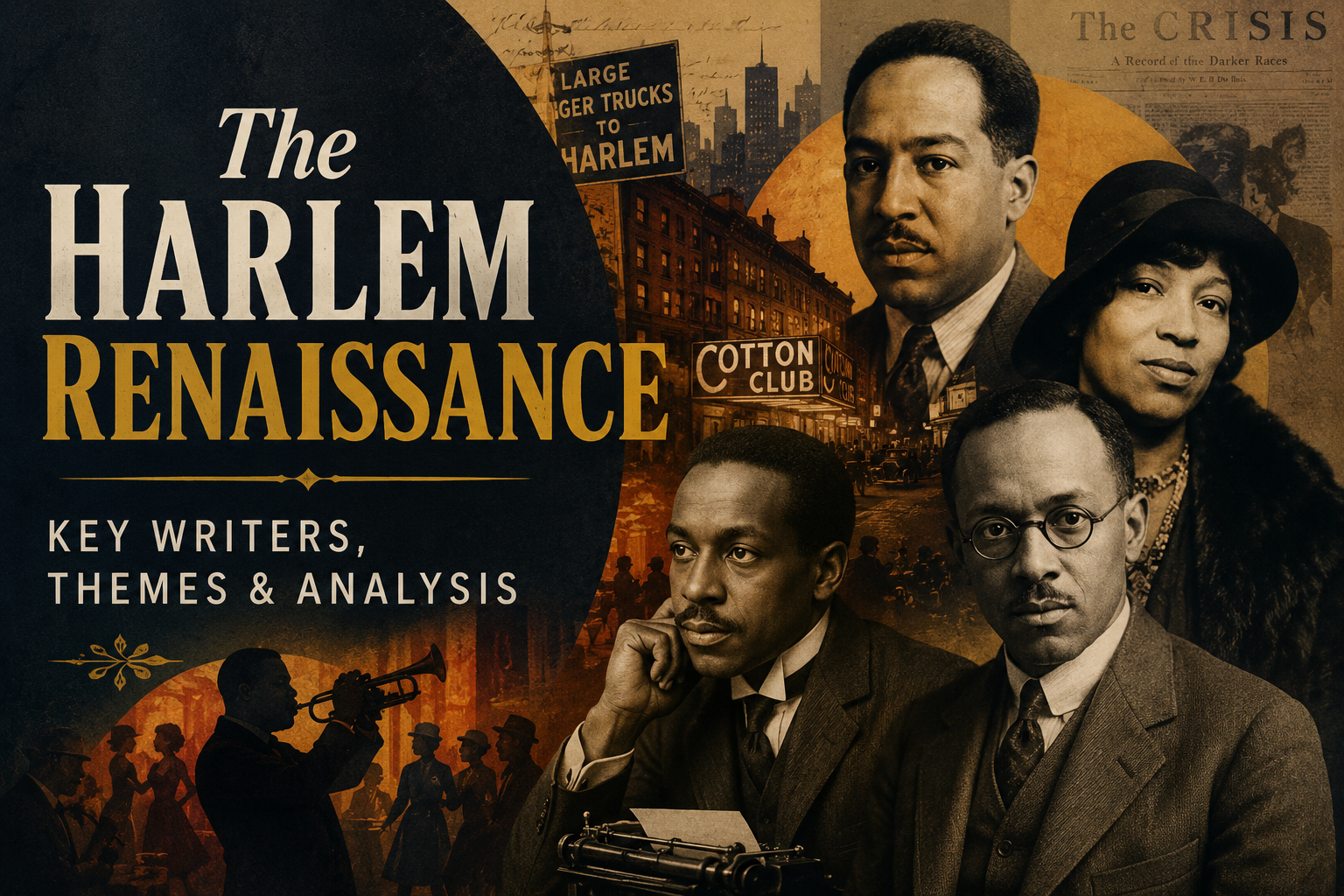
Imagine New York City in the 1920s. The Great War is over. Millions of African Americans have left the rural South — fleeing poverty, segregation, and the constant threat of racial violence — and flooded into northern cities. In Harlem, a neighbourhood in upper Manhattan, something extraordinary happens. Artists, writers, musicians, and intellectuals gather, and out of that gathering comes one of the most transformative cultural explosions in American history: the Harlem Renaissance.
The Harlem Renaissance was not simply a literary movement. It was a radical reimagining of what Black life, Black identity, and Black art could look like — on Black terms, in Black voices, with Black pride. For the first time in American cultural history, African American writers, poets, and thinkers commanded serious national attention. They did not just enter American literature. They changed it.
In this guide, we explore the Harlem Renaissance in depth — its historical roots, key themes, major writers, internal debates, and enduring legacy. Whether you are studying American literature, preparing for UGC NET English, or simply curious about one of the most culturally alive periods in literary history, this is the guide for you.
Quick Summary
The Harlem Renaissance was an unprecedented explosion of African American art and literature in the 1920s. Centredin Harlem, New York, this movement birthed the concept of the “New Negro.” Writers rejected older stereotypes and proudly celebrated their Black identity and heritage.
Langston Hughes used the rhythms of jazz and blues to capture everyday Black life. Zora Neale Hurston preserved rich Southern folklore and explored deeply personal female journeys. Meanwhile, Claude McKay wrote fiery poetry urging resistance against racial violence. Ultimately, this artistic awakening forced mainstream America to recognise Black intellectual power. It permanently changed American literature and laid the groundwork for the Civil Rights Movement.
What Was the Harlem Renaissance?
The Harlem Renaissance was a cultural, artistic, and intellectual movement among African Americans that flourished primarily during the 1920s and early 1930s. It was centred in the Harlem neighbourhood of New York City, which had become, through the Great Migration, the largest urban concentration of Black Americans in the United States.
To understand why it happened when it did, you need to understand the Great Migration. Between 1910 and 1940, nearly two million African Americans left the rural South to settle in northern cities. They were escaping Jim Crow laws, sharecropping, and the ever-present danger of lynching. They were moving toward the promise of industrial jobs, greater freedom, and a new way of being. Harlem became the epicentre of that new way.
In 1925, philosopher and critic Alain Locke edited a landmark anthology called The New Negro — a collection of essays, poetry, fiction, and art that announced, boldly and formally, that a new Black cultural identity had arrived. The “New Negro” was not the subservient, stereotyped figure of white imagination. The New Negro was educated, proud, creative, and politically aware. The anthology became the manifesto of the Harlem Renaissance.
It is important to note that the Harlem Renaissance was not only about literature. It encompassed jazz and blues music (Louis Armstrong, Duke Ellington), visual art, theatre, and pan-African intellectual thought. However, it is the literary legacy that has proven most durable and most central to American and global literary study.
Key dates to remember:
|
Key Themes of the Harlem Renaissance
The literary richness of the Harlem Renaissance lies in the breadth and depth of its thematic concerns. These were not writers retreating into aestheticism — they were writers wrestling with the most urgent questions of American life. Here are the central themes that define the movement.
1. Double Consciousness
The single most important theoretical concept of the Harlem Renaissance comes not from the 1920s but from W.E.B. Du Bois’s 1903 masterwork The Souls of Black Folk. There, Du Bois defines double consciousness as the sense of “always looking at one’s self through the eyes of others” — the peculiar, psychologically exhausting experience of being both Black and American in a society that treats those two identities as incompatible.
Double consciousness became the defining framework through which Harlem Renaissance writers understood their own experience. How does one live simultaneously as a full human being and as someone constantly filtered through the distorting lens of racism? Nearly every major work of the Renaissance — in one way or another — is an answer to that question.
2. Racial Pride and the New Negro
If double consciousness identified the wound, racial pride was the medicine. Harlem Renaissance writers were determined to reject the degrading stereotypes of Black people that dominated American culture — the lazy, comic, subservient figures of white imagination — and replace them with complex, dignified, fully human portrayals. This was not just artistic preference. It was a political necessity.
The “New Negro” was a cultural-political declaration: Black people would no longer accept the terms that white society had imposed. They would define themselves — their beauty, their history, their culture, their aspirations — on their own terms.
3. The Great Migration and Urban Identity
The movement from the rural South to the urban North was not simply geographical — it was psychological and cultural. Harlem Renaissance writers captured the exhilaration and the disorientation of that transition: the freedom of the city alongside its loneliness; the promise of northern life alongside its new, subtler forms of racism; the loss of southern roots alongside the excitement of urban modernity.
Jean Toomer’s Cane (1923) is perhaps the most formally sophisticated rendering of this transition — its three-part structure moving from the rural South to the urban North and back again, capturing in its very form the fragmentation of Black identity during the Great Migration.
4. Jazz, Blues, and the Folk Tradition
One of the most distinctive features of Harlem Renaissance writing is its deep embeddedness in African American musical and vernacular traditions. Langston Hughes was the master of this — his poetry absorbed the rhythms of jazz and blues, the cadences of Black speech, the improvisational energy of the music pouring out of Harlem’s clubs and churches.
Hughes’s poem The Weary Blues (1926) does not merely describe a jazz musician — it performs jazz, its lines bending and syncopating on the page. This insistence on Black vernacular as a legitimate literary language was radical. It said: our speech, our music, our culture — these are not deficits to be overcome. They are the source of our art.
5. Social Critique and Racial Justice
Beneath the cultural celebration ran a powerful current of political anger. Harlem Renaissance writers did not flinch from the realities of racial injustice: lynching, segregation, economic exploitation, and the hypocrisy of a democracy that excluded its Black citizens. Claude McKay’s sonnet If We Must Die (1919) — written in response to the race riots of the Red Summer — is one of the most defiant poems in the English language. Its call for dignified resistance, expressed in the most classical of European forms, is itself a statement about Black artistic and intellectual power.
6. Gender and Sexuality
The Harlem Renaissance was also a space where Black women writers and queer voices began to claim their own ground, often against resistance from both white society and Black male literary gatekeepers. Zora Neale Hurston and Nella Larsen wrote Black women’s interior lives with unprecedented depth and candour. The Renaissance’s bohemian subculture also provided, for a brief period, relative space for queer artists — Richard Bruce Nugent’s story Smoke, Lilies and Jade (1926) is one of the earliest works of openly queer African American literature.
Key Writers of the Harlem Renaissance
The Harlem Renaissance produced some of the greatest writers in American literary history. Here is a close look at the essential figures every student needs to know.
Langston Hughes (1902–1967)
Langston Hughes is, without question, the most iconic voice of the Harlem Renaissance — and arguably of twentieth-century African American literature as a whole. He was the poet of the people: of working-class Black life, of jazz clubs and tenement apartments, of dreams deferred and resilience maintained.
His debut collection The Weary Blues (1926) announced a radical poetics: verse that breathed with the rhythms of jazz and blues, that spoke in the vernacular of Black America without apology or translation. His most famous poem, Harlem (A Dream Deferred) — with its unforgettable question, “What happens to a dream deferred? / Does it dry up / like a raisin in the sun?” — remains one of the most quoted poems in American literature.
Key terms: Jazz poetry, Black vernacular, Harlem (A Dream Deferred), The Weary Blues, Blues poetry, and the voice of the people.
Zora Neale Hurston (1891–1960)
Zora Neale Hurston was a trained anthropologist and a powerful fiction writer. These two identities are inseparable in her work. She collected African American folklore throughout the American South and Caribbean. She then brought this material directly into her fiction. It served as the living heartbeat of her characters’ world, not just local colour.
Her masterpiece, Their Eyes Were Watching God (1937), follows Janie Crawford toward self-knowledge and authentic love. The novel uses a rich blend of dialect and lyrical prose. It offered the most fully realised portrait of a Black woman’s inner life at that time. Some peers, including Richard Wright, criticised Hurston for this. They felt her use of dialect was condescending. Alice Walker helped rediscover her work in the 1970s. Today, Hurston is widely recognised as a foundational literary figure.
Key terms: Their Eyes Were Watching God, anthropology and fiction, folk dialect, Black women’s selfhood, rediscovered by Alice Walker.
W.E.B. Du Bois (1868–1963)
W.E.B. Du Bois was the Renaissance’s intellectual godfather. His 1903 essay collection The Souls of Black Folk — written nearly two decades before the movement peaked — provided its philosophical foundation. The concept of double consciousness, the critique of Booker T. Washington’s accommodationism, and the argument that Black Americans needed full civil and political rights rather than mere economic self-improvement all shaped the intellectual climate in which the Renaissance flourished.
As editor of The Crisis (the magazine of the NAACP), Du Bois also provided a crucial institutional platform for Harlem Renaissance writers, publishing early work by Langston Hughes, Jessie Fauset, and others.
Key terms: Double consciousness, The Souls of Black Folk, The Talented Tenth, The Crisis magazine, the veil, the colour line.
Claude McKay (1889–1948)
Born in Jamaica, Claude McKay brought a diasporic, pan-African perspective to the Harlem Renaissance. He was one of its most politically radical voices — a committed socialist who saw Black liberation as part of a global struggle against colonial capitalism. His poetry is remarkable for its technique: McKay used the traditional European sonnet form — the form of Shakespeare and Milton — as a vehicle for radical Black protest.
His poem If We Must Die (1919), written in response to the race riots of the Red Summer, called for dignified, defiant resistance against racial violence. The novel Home to Harlem (1928) depicted working-class Black life with frank sexuality and gritty realism — provoking both admiration (from Hughes) and condemnation (from Du Bois, who called it “filth”).
Key terms: Sonnet form for protest, If We Must Die, Home to Harlem, pan-African, the Jamaican perspective, radical socialism.
Nella Larsen (1891–1964)
Nella Larsen wrote just two novels — Quicksand (1928) and Passing (1929) — but they are among the most psychologically acute works of the Renaissance. Passing explores the dangerous, thrilling act of a light-skinned Black woman “passing” as white in 1920s New York — navigating the fault lines of race, class, desire, and identity with an intensity that reads as startlingly modern.
Larsen’s fiction is particularly important for feminist literary criticism. Her protagonists are Black middle-class women whose desire for autonomy, pleasure, and full personhood is systematically frustrated — by racism, by patriarchy, and by the respectability politics of the Black bourgeoisie itself.
Key terms: Passing (racial), Quicksand, the Black bourgeoisie, female desire, racial identity, light-skinned experience.
Jean Toomer (1894–1967)
Jean Toomer’s Cane (1923) is the most formally experimental work of the Harlem Renaissance — a genre-defying hybrid of poetry, prose sketches, and drama that remains one of American modernism’s most innovative texts. Its three-part structure traces a journey from the rural South to the urban North and back, capturing the Great Migration’s psychological toll in its very form.
Toomer himself resisted racial categorisation, refusing to identify publicly as Black after Cane’s publication – a decision that alienated him from the Renaissance community but also raises fascinating questions about the relationship between racial identity and artistic production.
Key terms: Cane, hybrid form (poetry + prose + drama), Great Migration, American modernism, racial ambiguity.
The Harlem Renaissance: A Comparison Table of Key Writers
The table below offers a quick, exam-ready summary of the Harlem Renaissance’s most important literary figures:
| Writer | Genre | Key Work | Core Theme | UGC NET Relevance |
| Langston Hughes | Poetry, fiction | The Weary Blues (1926) | Jazz aesthetics, Black vernacular | Very High |
| Zora Neale Hurston | Novel, folklore | Their Eyes Were Watching God (1937) | Black women’s self-discovery | Very High |
| W.E.B. Du Bois | Essay, sociology | The Souls of Black Folk (1903) | Double consciousness | Very High |
| Claude McKay | Poetry, novel | Home to Harlem (1928) | Radical protest, diaspora | High |
| Nella Larsen | Novel | Passing (1929) | Racial identity, ‘passing’ | High |
| Countee Cullen | Poetry | Colour (1925), Heritage | European form + Black content | Moderate |
| Jean Toomer | Hybrid prose-poetry | Cane (1923) | Great Migration, modernism | High |
| Alain Locke | Essay, anthology | The New Negro (1925) | Cultural nationalism | High |
Why Does the Harlem Renaissance Still Matter?
The Harlem Renaissance did not simply produce great literature. It changed the conditions under which African American literature was written, published, read, and taken seriously. Its legacy is woven into everything that followed.
The direct literary lineage is extraordinary. Richard Wright, Ralph Ellison, James Baldwin, Lorraine Hansberry, Maya Angelou, Toni Morrison — none of these writers is fully comprehensible without the Renaissance. Morrison’s insistence on Black interiority, Baldwin’s fusion of the personal and the political, Ellison’s exploration of Black invisibility in American life — all of these are in direct conversation with the Renaissance writers who came before.
Du Bois’s concept of double consciousness remains arguably the most widely cited framework in African American studies. Contemporary writers and thinkers — from Ta-Nehisi Coates to Jesmyn Ward — explicitly acknowledge its relevance to twenty-first-century Black American experience.
The movement’s cultural reach extended far beyond America. The Harlem Renaissance directly inspired the Negritude movement in French-speaking Africa and the Caribbean — a literary and intellectual movement led by Aimé Césaire, Léopold Sédar Senghor, and others that asserted the value and beauty of African cultural identity in the face of French colonialism. In this sense, the Harlem Renaissance was a global literary event.
Today, when debates about racial justice, Black representation, and the politics of art rage across culture — from Black Lives Matter to arguments about diversity in publishing — the Harlem Renaissance remains not a historical curiosity but a living conversation. Its central question — who gets to tell Black stories? For whom? In whose language? — are the questions of the present moment.
“Did this breakdown help you? Keep the momentum going! 👉 [Click Here to Explore the Complete Chronological Guide to English Literature]”
The Harlem Renaissance and UGC NET English: What You Need to Know
| UGC NET English — Exam Focus: The Harlem Renaissance and African American writers form a key unit in the American Literature component of UGC NET English Paper 2. Here is exactly what to focus on: Most examined authors:
Must-know terms:
Quick recall tip: Hughes = jazz + the people | Hurston = folk + women | Du Bois = theory + uplift | McKay = protest + diaspora | Larsen = race + desire |
“To truly understand the Harlem Renaissance, you must read the raw, revolutionary texts that defined it. 📚 Zora Neale Hurston’s Their Eyes Were Watching God and Langston Hughes’s poetry are absolute essentials for your syllabus. Build your American Literature library and grab your copies here”
Conclusion:
The Harlem Renaissance was, at its heart, an act of collective self-definition. For the first time in American cultural history, African American writers, artists, and thinkers asserted — loudly, beautifully, and in every literary form available — that Black life was worthy of serious artistic attention, that Black culture was a treasure rather than a deficit, and that Black voices belonged at the centre of American literature, not at its margins.
From Langston Hughes’s jazz rhythms to Zora Neale Hurston’s folk-soaked prose, from W.E.B. Du Bois’s double consciousness to Nella Larsen’s knife-edge explorations of racial identity, the Harlem Renaissance gave American literature some of its most enduring voices and most urgent questions. Those questions — about who belongs, who is seen, whose story is told – are as alive today as they were in 1920s Harlem.
Understanding the Harlem Renaissance does not just prepare you for an examination. It equips you to read all literature — American and otherwise — with a sharper eye for whose voices have historically been silenced and whose have been amplified and why that difference matters.
Enjoyed this guide? Explore more on a2zliterature.com — including our guides on Modernism vs Postmodernism, Feminism in Indian English Literature, and Postcolonial Theory.
Frequently Asked Questions
What was the Harlem Renaissance and why was it important?
The Harlem Renaissance was a cultural, artistic, and intellectual movement among African Americans that flourished primarily in the 1920s and early 1930s, centred in Harlem, New York. It was important because it was the first major moment in American cultural history when African American writers, artists, and thinkers commanded serious national attention on their own terms.
What is the New Negro Movement?
The New Negro Movement refers to the cultural and intellectual awakening of African Americans in the 1920s, particularly as articulated in Alain Locke’s 1925 anthology The New Negro. The term “New Negro” signified a rejection of the stereotypes and subordination imposed by white society and an assertion of Black pride, cultural achievement, and political self-determination.